

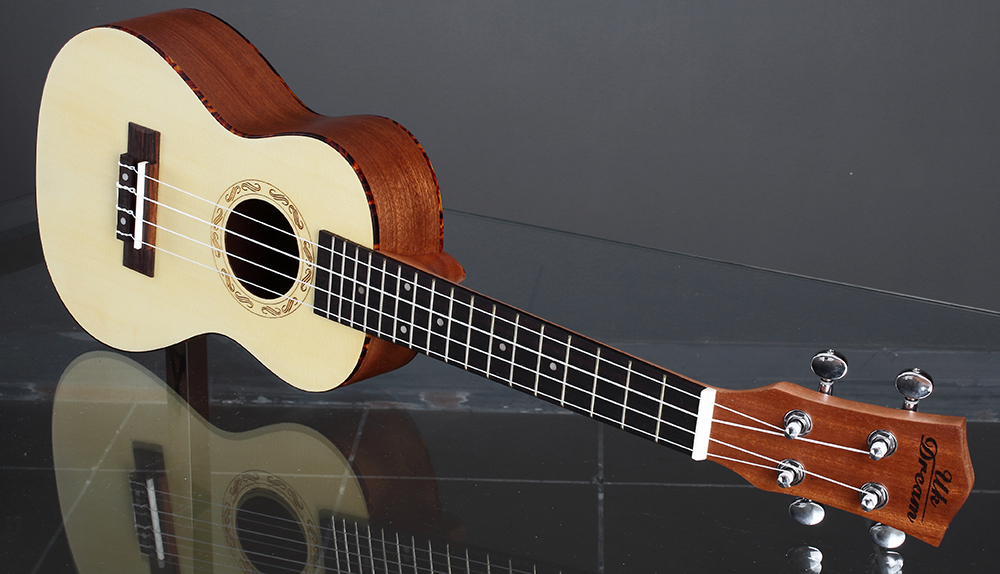
Ukulele is also known as "Ukulele", and the fret is "12"'15'17"19"...The front panel of the piano is mostly acacia, mahogany, spruce, "red pine" and back panel "rose" "Wood"..."Ukulele" from "Hawaii" uses good materials.
[3] Recognizing open strings
Face your ukulele, and the first numbered musical notation from the right is 6, and the sound is A. The second numbered musical notation is 3 and the sound name is E. The third numbered musical notation is 1, the sound name is C, and it is also the thickest one. The fourth numbered musical notation is 5, and the sound name is G. From right to left, that is, from the first root to the fourth root, they are 6, 3, 1, and 5 in order.
[3] Pick up correctly
Pick up the head of the ukulele and hold the neck for easy pressing. The back of the guitar is close to the belly, and the other arm slightly clamps the tail of the ukulele. From the previous introduction, we know that the bounces from top to bottom are 5, 1, 3, and 6.
Turn on the tuner
After installing the battery, press and hold the start button to boot. Short press the start key to adjust the five letter options C, G, B, V, U. They represent twelve equal temperament, six-string guitar, bass, violin, and ukulele respectively. We need to adjust to U option.
Install the tuner
Clamp the clip of the tuner to a location where the ukulele vibrates. Generally speaking, it is mostly clamped on the headstock, so that it is convenient to observe the changes of the display screen.
Start tuning
When the display pointer is shifted to the right and the display is white, the sound is higher.
Immediately rotate the tuning handle to center the pointer, and the screen will be highlighted in green at this time, and the tone will be aligned.